
Cosmic Caesious, Cosmic Zinnober, Cosmic Celadon, Cosmic Virescent
Tai Shani
88pp / 125mm x 190mm
5 colour illustrations
Paperback with flaps
£12.00
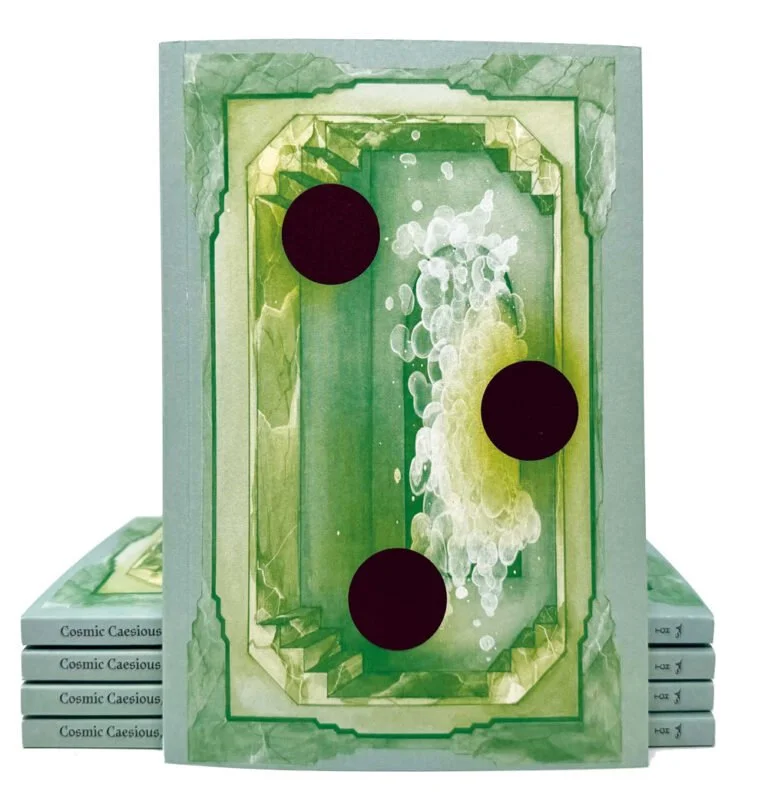
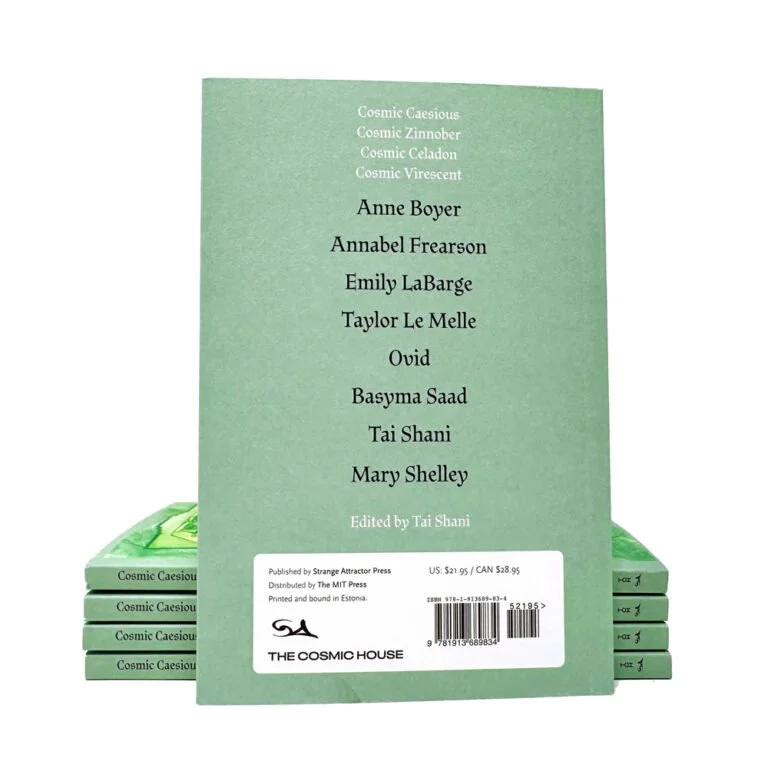
Essays that trace connections between the work of Turner Prize-winning artist Tai Shani and the intellectual legacy of Charles Jencks, one of postmodernism's most playful architectural thinkers.
In this newly edited collection of essays, leading writers trace connections between the unique work of Turner Prize-winning multi-media artist Tain Shani, and the intellectual legacy of Charles Jencks, one of postmodernism's most playful architectural thinkers.
Catalysed by Shani's exhibition The World To Me Was A Secret: Caesious, Zinnober, Celadon, And Virescent, developed for The Cosmic House in 2024, this far-reaching book draws upon the various mythologies metabolised by Mary Shelley's Frankenstein; or, The Modern Prometheus. A surrealist exquisite corpse made real, the writings gathered here reanimate Frankenstein's Monster within Jencks' definition of Ad-Hocism, whereby the use of materials and objects for unintended purposes, might yield surreal results.
A collaboration between The Cosmic House and Strange Attractor Press, Cosmic Caesious, Cosmic Zinnober, Cosmic Celadon, Cosmic Virescent includes newly commissioned works by Anne Boyer, Annabel Frearson, Emily LaBarge, Baseman Saad, and Taylor Le Melle that explore themes of anthropomorphism, the tangled legacies of surrealism, and the Promethean impulse. The book also includes a foreword by Eszter Steierhoffer, Director of The Jencks Foundation, and an introduction and original text by artist Tai Shani.
————————
About the author
Tai Shani is an artist living and working in London, UK. Shani’s artistic practice, comprising performance, film, photography and installation, uses experimental writing as a guiding method. Oscillating between theoretical concepts and visceral details, Shani’s texts attempt to create poetic coordinates in order to cultivate, fragmentary cosmologies of marginalised non-sovereignty. Taking cues from both mournful and undead histories of reproductive labor, illness and solidarity, her work is invested in recovering feminised aesthetic modes—such as the floral, the trippy or the gothic—in a register of utopian militancy.
In this vein, the epic, in both its literary longform and excessive affect, often shapes Shani’s approach; her longterm projects work through historical and mythical narratives, such as Christine de Pizan’s allegorical city of women or the social history of psychedelic ergot poisoning. Extending into divergent formats and collaborations, Shani’s projects examine desire in its (infra-)structural dimension, exploring a realism that materially fantasises against the patriarchal racial capitalist present.